David Hakaraia - Matariki and other Māori designs
Posted by Lynette Townsend on 30th Sep 2026
David Hakaraia (Ngāpuhi, Ngāti Paoa) began working with NZ Post about twelve years ago. Our first projects together were in 2014 when he designed a wakahuia coin box developed in partnership with Rangi Kipa for the Ranginui and Papatuanuku coin designed by Cliff Whiting, and in 2018 when he designed the Te Ika-a-Māui (Māui and the Fish) stamps. Since then, Hakaraia has designed many coins, and most recently the Matariki 2026 stamps.
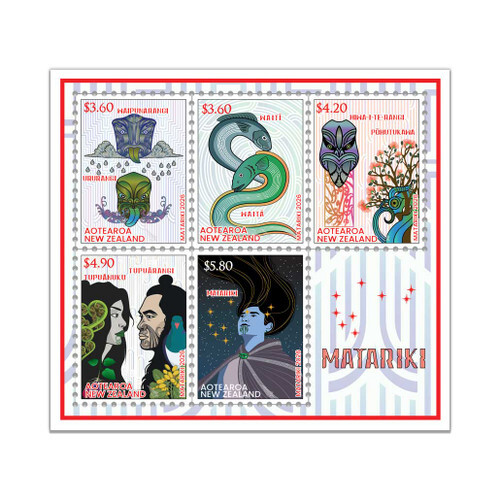
Matariki 2026 stamps designed by David Hakaraia
The Matariki 2026 stamp issue depicts visual interpretations of the nine stars in the Matariki star cluster. Typical of Hakaraia’s design work, the stamps incorporate elements of contemporary Māori art and fine details that are representative of traditional carving and weaving patterns. The stamps traverse historical and contemporary Māori art forms through Hakaraia’s distinctive design aesthetic.
Hakaraia particularly enjoys the challenge of designing coins and stamps. He explains that it is the challenge of the medium and the creative process that he most enjoys:
“Most of my practice is in product design, lighting, public art and the built environment, so coins and stamps allow me to think much more graphically. You're trying to take a complex idea and communicate it within an incredibly small and constrained format, which is a really interesting design challenge.”
Hakaraia finds it rewarding to bring Māori narratives to life in a contemporary way. His influences are quite broad and include Māori artists, carvers and designers who demonstrate that Māori visual culture isn't frozen in the past.
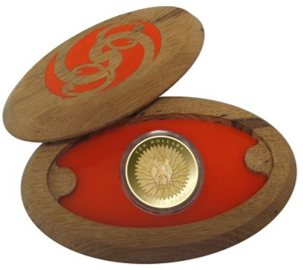
Wakahuia coin box designed by David Hakaraia and Rangi Kipa, 2014
Rangi Kipa, with whom Hakaraia designed the Ranginui and Papatuanuku wakahuia coin box, has been a significant influence. This is particularly true in terms of developing an understanding of Māori art as a living evolving art form. Hakaraia explains that he has known Rangi for a long time and has been fortunate to learn from him through various creative projects that they have worked on together.
“I really admire the way he understands customary practice but isn't constrained by it. He's always looking at how that knowledge can move forward through contemporary materials, processes and technologies.”
Other influences include mid-century design, particularly the work of American industrial designers Charles and Ray Eames. He is drawn to the simplicity of the work, but probably even more so to their experimentation with materials and manufacturing.
He is also attracted to work that sits somewhere between art, design, craft and architecture, where those boundaries become less important. “That's increasingly where my own practice sits,” Hakaraia explains.

Tāne Mahuta coin by David Hakaraia, 2022
Whānau, iwi and other influences
Hakaraia is deeply influenced by his Māori heritage and early life growing up around Tokoroa and Kororāreka (Russell). As he has learnt more about his whakapapa and mātauranga Māori, it has increasingly shaped his design practice, research and the way he teaches at Te Herenga Waka—Victoria University of Wellington.
“I'm interested not simply in reproducing traditional Māori forms or motifs, but in understanding the thinking, values and systems behind them; whakapapa, tikanga, relationships to whenua and materials, and the way knowledge is passed between generations.”
Other aspects of Hakaraia’s early years continue to be an influence too. He was into comics, cartoons and anime, and remembers watching Akira and being ‘blown away by it’. Comics had a similar effect. Hakaraia loved the drawing and storytelling, but particularly the idea that someone could create an entire world through images. From there he progressed onto reading a lot of science fiction and fantasy.
His early interest in anime also gave him a real fascination with Japan and Japanese culture, and he ended up living in Japan for three years. It gave him a much broader appreciation of Japanese design and the Japanese attention to detail in everyday things - from architecture, objects and graphics through to craft, fashion, packaging. He was also really interested in the way tradition and contemporary culture seemed able to sit alongside each other.
Another aspect of Hakaraia’s design aesthetic and approach developed while in the Royal New Zealand Navy where he was employed as an engineer. Hakaraia learnt to understand systems, be precise and solve practical problems. He explains that when he eventually discovered design, he could use that same ways of thinking. Instead of only asking ‘how does this work?’, he asked ‘how could this work differently? What could be changed?’ Hakaraia left the Navy to pursue design taking with him a well formal critical thinking approach.
Major design projects
Hakaraia has achieved several significant projects outside his Te Herenga Waka—Victoria University of Wellington work. Designing the Man of the Match trophies for the 2011 Rugby World Cup was a big highlight. Another project with Te Kāhui Tika Tangata/Human Rights Commission was a standout as he was able to work closely with architects and long-time collaborator Rangi Kipa. This project demonstrated the ways Māori values and narratives could genuinely inform a space.
The National Library waka hourua project was a highlight as it brought together ideas around navigation, whakapapa and Te Tiriti. Another groundbreaking project was ‘The Living Pā’ at Te Herenga Waka—Victoria University of Wellington. Hakaraia regards this as one of the projects he has most enjoyed. “It was kaupapa Māori-driven from the beginning, and everyone involved genuinely engaged with that Kaupapa,” says Hakaraia. At the same time, there was a huge amount of technical and environmental innovation involved in meeting the Living Building Challenge. His Hononga research has further challenged him, says Hakaraia, allowing him to explore how relationships, co-design and engagement with mana whenua shape the design process itself.
The stamp issue wasn’t the only Matariki project Hakaraia was engaged with in 2026. For several years he has lead the development of Matariki experiences shown on the Wellington waterfront.

Matariki on Wellington Waterfront. Image courtesy of David Hakaraia and Wellington City Council.
Across all projects, Hakaraia has increasingly aimed to move away from the idea of adding Māori patterns or artwork at the end to make something look Māori. He believes the cultural thinking should be there from the beginning to influence the relationships, decisions, materials, form and experience of the project.